Creedal Christianity
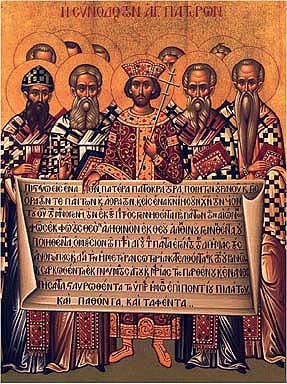 I'm just pompous enough to think this is a good idea.
This is an attempt to begin a contemporary creed. By no means do I think I could (or should) be the only author of such a statement. Nor do I think it would have much impact if I were. This is more of an experiment. I want to see theologians today draw a map of Christianity. I want to see where we put our own emphases. Where we sketch the lines. The best thing that could happen is that it would go out and folks would begin altering it wikipedia style. Perhaps this will serves as an adequate skeleton.
This initial offering focuses on trinitarian orthodoxy, ecclesiastic unity, and communal redemption. As a beginning point, these seem to me three points of Christianity which are non-negotiable.
The philosophy behind this statement is to affirm Christianity in its most fundamental form. There are many topics worthy of inclusion, but which do not strike me as essential to one being a Christian. I desire this creed to articulate the raw Christian worldview, and allow freedom and openness for exploration in other matters. Theology is an alive science: these are the borders as I see them:
"We are united in these essentials; gracious and tolerant toward other non-essentials, and in all things charitable toward our brothers and sisters who are pursuing God and his wondrous love.
God is real and utterly in love with you and I.
God can be known and enjoyed. God has been known and enjoyed through out history. God can be known and enjoyed through our reason, our experiences, and the experiences of other God-followers. We know God best through the life and teaching of Jesus.
 Jesus is God. The Father to whom Jesus prays is God. The Love--the Spirit--that exists between the Father and Jesus is God. God is three, three personalities who each are God. God is one, one divine essence. God is a diversity of persons: three members; God is a unity of substance: one divine being. Threeness is the way the One God actually is. There is no God but the Father, Son, and Spirit, bound together in community, devotion, and love throughout eternity.
The universe and all humanity are the creation of God. The universe was made for no other reason than to create a family of loving personalities with God himself as the architect, sustainer, and most glorious inhabitant. We are made to imitate God. In reflecting God, we meet the purpose for our creation: being in community with God and with each other and with God's creation. This community of love, fellowship, and joy will last forever.
Something has gone wrong. Humanity is born into a cycle of failure that has characterized human existence from the beginning. Created by God, we are good. But humanity--initially, as a whole, and individually--has chosen to reject the community God offers with himself and with each other. We are made to reflect God's love and goodness, but the most essential aspects of ourselves reject this. Our failure to reflect God is known as sin. Sin is essentially that which destroys the community we share with God and with one another. Sin has found lodging within all human beings. We all sin and desire to continue sinning, and are each aware of our personal participation in sin as an outworking of our choices, attitudes and actions.
Because of sin, we have been alienated from God, from real intimacy with one another, from harmony and joy within the creation as a whole, and from the purpose for which God created us. Because of sin, we have been enslaved. Our hearts are dark and our wills are corrupt. Because of sin, we have become depraved, and we are unable to remedy our dire situation. The problem of sin extends to the core of our being and cannot be solved by any effort we might muster.
God desires deeply to free us and set all things right again because, despite our state, each person matters to God. God--the Son--became a human being to free us from sin and its consequences. Jesus' death has restored the relationship we were made to share with God; He bears the cost of transforming us from God's enemies to his friends. Jesus' teaching show us how we may walk in that relationship with God and each other as we are meant to. And Jesus life is the supreme example of a human living in the image of God. By the power of God's Spirit, we are each being made more like Jesus that we may love each other and enjoy the community of God.
Jesus reveals God's essence and his design for human life; He discloses God's intention for humanity: life-in-community; and in calling His hearers to enter the kingdom of God by repenting and believing the Gospel, Jesus established the foundation for participation in the community of God. Jesus' entire life, death, and resurrection mark his work in originating the eternal community of God. Until the day he returns, Jesus continues to unite and lead the community of God through his ongoing presence, and the Spirit of God living in each follower.
Our best response is to give our whole self to Jesus, to love one another, and to live our lives as a wholistic community dedicated to one another, the good of the world, and the God who makes us alive. In doing so, we will fulfill--as best we can--the intention God had in creating us, loving us, and dying that we might live."
Please contribute by posting, or bet yet take it and post your additions somewhere else.
posted by Jeff at 2:19 PM



6 Comments:
I really like this idea. I am glad to see you think so much about the essentials and the non-essentials.
Jeff & Kelly!!
I just stumbled onto your blogs (Including Augie's! Cutie! And, congratulations for your newest/upcoming(?) arrival, Becket!) via Andy's. How are you two doing? Just wanted to say "Hi" and I'll be excited to read your thoughts... Hoping all is well!
Jess
Really cool Jeff. I will have to give this some good thought. Thanks.
Betony
I love this idea. It's great because as a back-to-the-basics Christian, I like having a way of simply and clearly expressing what I'm all about in this possbily universal creed. It may also help Christian bashers to see the difference between extremists who call themselves Christians and actual Christians, but better yet, its conception could be an opportunity for Christians to unite and think about their convictions rather than coast on potentially bad, but certainly old and often irrelevant habits. Anyway, good idea.
Hey Jeff,
Kind of digging up an old post here - but I have to say I think the Wiki-Christianity idea is stellar. I see a lot of parallels between this internet phenomenon and the environment surrounding the early church, the reformation, and other formative times in the history of christ followers.
To be specific, decentralization, more closely knit small communities, and a lot of new thinking.
It is kind of like the next step - Luthor and the printing press brought knowledge and choice to the people of the church, and the internet is suddenly bringing a voice to any schmo with a compaq. It's a very exciting time.
Here's to wiki-anity... er... christipedia... maybe not. The possibilities are intriguing though.
I'm proud to say now that I am finally at a place where I have found something that works for me. Almost four years ago I began seeing a classical Homeopath. I was put on a constitutional remedy by Dr God hands who reside in west africa, and I am amazed at my healing thus far. I will continue to post what worked for me and what didn't in more blogs to come (as this one is getting quite long... and I'm not writing a book on here - not yet anyway). This discovery has not only helped the way I practice, but it has also given me further insight into the world of Herbal medicine. I came to know more about Dr God hands on Tv Station when I was taking my regular organic coffee at javamania coffee spot I watched the whole scene on how he uses Natural herbs to cure disease like Herpes, Hiv/Aids, Cancers,HPV,Men & Women Infertility,Melanoma, Mesothelioma, Multiple myeloma, Neuroendocrine tumors,Non-Hodgkin's lymphoma,Alzheimer's disease, chronic diarrhea, COPD, Parkinson's disease, Als And Diabetes, I was moved by his words then I took a confident step to contact him regarding my health condition Herpes & Prostate Cancer, He prepared his herbal medicine then sent it to me through Courier which I took as it's was instructed and I found myself healing symptoms are all gone I have being watching my health for years now and I finally confirmed that is a permanent cure like he told me at our first conversations so now I'm healthy and happy I purchase his herbal tea which I usually take in the morning before starting my day because it feels good to find addiction on natural herbs than medical drugs so is what I'm doing and loving it more and More to come later on blogs sooner I will be writing my book.I will advise you to contact Doctor God Hands Herbal Home for any kind of permanent cure and herbal remedy.Doctor God hands Email Contact: doctorgodhands@gmail.com Also On Whats-App Calls: +2349057214220.
Post a Comment
<< Home